For leaders
Accountability that works: lead measures, the weekly reckoning and the quarter
Accountability doesn't come from reminders but from structure: one most important goal, lead measures, a weekly reckoning and sprints. How to build it for yourself.
7 minMANIFESTOI editorial
Why doesn't accountability work with reminders?
Most people try accountability with reminders: a calendar entry, an app notification, a friend who asks. They work for a week. Then the reminder becomes background noise, and the friend stops asking because the answer is always "next week".
Accountability isn't remembering. It's a structure where promise and result sit side by side so the gap can't be ignored.
1. One most important goal for the quarter
When there are ten goals, none is the most important. The quarter starts with one goal (three at most), chosen by asking: what one thing would make everything else easier or unnecessary?
The goal is a lagging measure: you only see it once it has happened. That's why you also need lead measures.
2. Lead measures
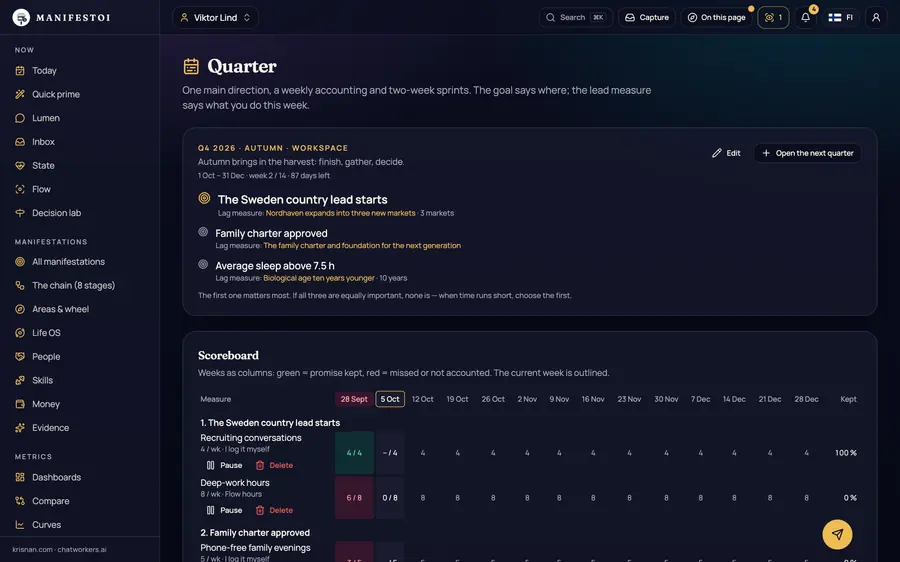
A lead measure is an action that predicts the goal and that you can influence this week. If the goal is "the Sweden country lead starts", a lead measure might be "four recruiting conversations a week".
A good lead measure is:
- predictive – when it happens, the goal is likely to happen
- influenceable – you can do it yourself this week
- measurable – a number, not a feeling
3. The weekly reckoning
From Friday to Monday you go through every lead measure: what I promised, what I did. No explanations, just numbers. The gap is written down, and a new promise is made for next week – more realistic or more courageous.
The reckoning isn't punishment. It's the one moment in the week when promise and reality look each other in the eye.
4. Sprints and the retrospective
A two-week sprint gathers steps around one goal. At the end, three questions: what worked, what didn't, what will I try next. The last answer becomes an experiment tested in the next sprint.
What does the scoreboard do?
The scoreboard shows lead measures week by week in colour: met, partly, missed. When the board is visible, the pattern reveals itself: which weeks the numbers drop and what came before. Often it's sleep, travel or too many meetings – and only once you see it can you do something about it.
Do I need a coach?
A coach makes accountability personal, and that's valuable. But a coach needs structure too: without numbers the conversation stays in moods. The best combination is a structure the coach can see – and that you see even when the coach isn't there.
How does MANIFESTOI build accountability?
In MANIFESTOI the quarter, lead measures, the scoreboard, the weekly reckoning and sprints live in one view. The reckoning appears in the Today view from Friday to Monday, and the Sunday weekly letter gathers what worked and what repeats. You also name an accountability partner in your dream team who asks the right question on the right day.
Read more for leaders or apply for membership.
Frequently asked
What is a lead measure?
A lead measure is an action that predicts the goal and that you can influence this week – for example recruiting conversations per week when the goal is a new country lead.
How do you do a weekly reckoning?
Go through each lead measure: what you promised and what you did. Write down the gap without explanations and make a new promise for next week.
How many goals should a quarter have?
One most important, three at most. With more goals, none of them is the most important.

Membership is granted by application. The investment is discussed personally once the fit is confirmed.