Decisions
Decision quality, measured: the decision journal, calibration and intuition
Decision quality can be measured: record your expectation and confidence before deciding, review afterwards and see where your intuition hits. How to build your own decision journal.
7 minMANIFESTOI editorial
Why is decision quality hard to judge?
Because the outcome muddies the picture. A good decision can end badly through bad luck, and a bad decision can succeed by chance. If you judge decisions only by their outcome, you learn the wrong lessons.
The only way to separate the decision from the outcome is to record, at the moment of deciding, what you knew, what you expected and how sure you were.
What is a decision journal?
A decision journal is a simple log. For every significant decision you record:
- the question – what is being decided
- the options – what was on the table
- the choice – what you decided
- the expectation – what you believe will happen
- the confidence – 50–100 per cent
- the review date – when you'll look at what happened
On the review date you record the outcome (right, wrong, unclear) and the lesson.
What does calibration mean?
Calibration tells you whether your confidence matches reality. If you make ten decisions at 70 per cent confidence, a well-calibrated decision-maker is right about seven times. If you hit three, you're overconfident. If you hit ten, you're probably too cautious – and leaving opportunities unused.
Calibration improves with practice, but only if feedback arrives. That's why the review date is the most important field in the journal.
Can intuition be measured?
Yes. Intuition is fast reasoning from experience, and it's excellent in some areas and poor in others. The only way to know which is to log the hunch before the outcome: what you sense, in which area (people, money, timing, risk) and what kind of signal (body, image, words, knowing).
After a few months you may see, for example, that your hunches about people usually land but your hunches about money don't. That's valuable: trust the former, check the latter.
Which thinking tools help?
Different situations call for different tools:
| Situation | Tool |
|---|---|
| A big, irreversible decision | Inversion: how would this certainly fail? |
| Fear is holding you back | Fear-setting: define, prevent, repair – and the cost of inaction |
| Too many options | Opportunity cost: what do I give up by choosing this? |
| Emotions cloud judgement | 10–10–10: how will this feel in ten minutes, a month and a year? |
| Stuck in an old model | First principles: what is certainly true? |
How do mistakes become principles?
When a review reveals a mistake, ask: what situation was this, what would I do differently and why. Write the answer as a principle: "When …, I …, because …". When the same situation comes back, the principle is ready. Over time the mistake log becomes a principles book.
How does MANIFESTOI help with decisions?
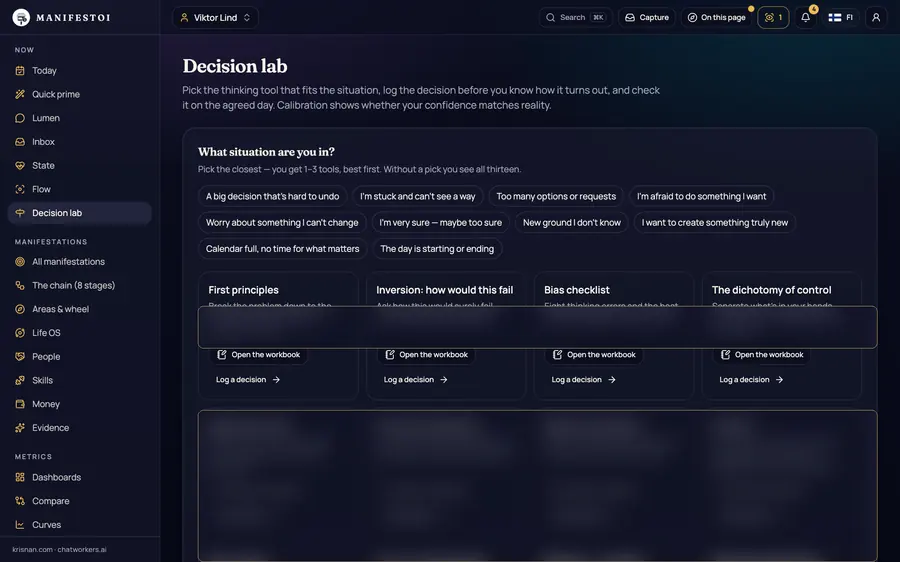
MANIFESTOI's decision lab combines a situation picker, thirteen thinking tools, a decision journal, a calibration curve and review reminders. The hunch log measures intuition accuracy by area, and the principles book turns mistakes into rules used in the next decisions.
Read more for investors and leaders, or apply for membership.
Frequently asked
How can decision quality be measured?
Record your expectation and confidence before deciding, review the outcome on an agreed date and track calibration: do decisions made at a given confidence land the matching share of the time.
What is a decision journal?
A log recording each decision's question, options, choice, expectation, confidence and review date – and at review, the outcome and the lesson.
Is intuition reliable?
In some areas it is, in others not. By logging hunches before the outcome you see where your own intuition lands.

Membership is granted by application. The investment is discussed personally once the fit is confirmed.